
About The Esther Practice
The Esther Practice™ addresses patterns of racial harm that are often experienced, minimised, or left unnamed.
The name draws on the story of Esther, not as symbolism, but as a point of reference. A moment where what is happening behind the scenes is brought into the open, named for what it is, and can no longer be ignored.
The practice was founded by Dionne Wilson-Brown. The work is shaped by experience across public sector practice, community development, and counselling training. It is grounded in a direct understanding of how harm operates within working environments, where many of us spend most of our adult lives. This includes the quieter forms of harm that are often overlooked but are no less damaging.
The Story Behind the Name

In a season that should have been devastating, I was in Jamaica when a sister in Christ called with a word for me.
Days later, I woke to find the Bible had blown open at the Book of Esther. Because of that word, I photographed it.
That trip was when I gave my life to Christ.
Eighteen months later, I was naming a practice of my own. I had never seen myself as a business owner. But we serve a God of suddenly. Working through name after name, it came to me:
The Esther Practice.
Dionne Wilson-Brown
Founder
Why I built this practice
My maternal grandparents came to Britain as part of the Windrush generation. I was raised by my mother in Tottenham, North London, in the aftermath of the Broadwater Farm uprising. I learned early how systems treat communities like mine, and how rarely that treatment is named for what it is. I also saw my community resist and demand better. That gave me a strong sense of who I am. It did not, however, protect me from racism. Nobody is protected from it.
Across more than forty years, in different organisations, under different leaders, years apart, I saw the same dynamics play out. Each time, they were treated as isolated incidents. A misunderstanding. A personality clash. A one-off.
I never saw them as separate. The same patterns kept repeating, and I began to ask whether they could be evidenced: coded, named and traced, so that what happened could be seen rather than argued about. That question became the method at the heart of this practice.
As I developed that work, I began to see the same dynamics operating much earlier. The patterns do not begin in the workplace. Many are learned, normalised and reinforced long before people enter employment. I saw how little voice a child has in school, and how much the way adults understand a child shapes who that child becomes. As a mother, I have seen how Black children are perceived. Black boys’ energy is read as aggression, their questions as defiance. Black girls are seen as older than they are, their confidence read as attitude, their need for protection overlooked. Those perceptions do not stay in the classroom. They feed exclusion, and exclusion feeds what has rightly been called the school-to-prison pipeline.
The work widened from understanding harm in organisations to understanding how institutions shape identity, belonging and possibility from childhood onwards.
I believe God places us where He needs us. Like Esther, I did not always understand why I was where I was, or why it was costing what it cost. Reading her story changed that. She was positioned for a purpose, and when the time came, she had to act. For me, this practice is obedience.
Nobody should have to give up their dignity for a wage. Or to be treated as a patient, taught as a pupil, housed as a tenant, or heard as a parent. Racialised harm is not confined to one sector. It is met in any institution, simply for existing as a Black person within it.
This work exists to change that.

Where Esther entered my story, before I knew what she would mean to this work.
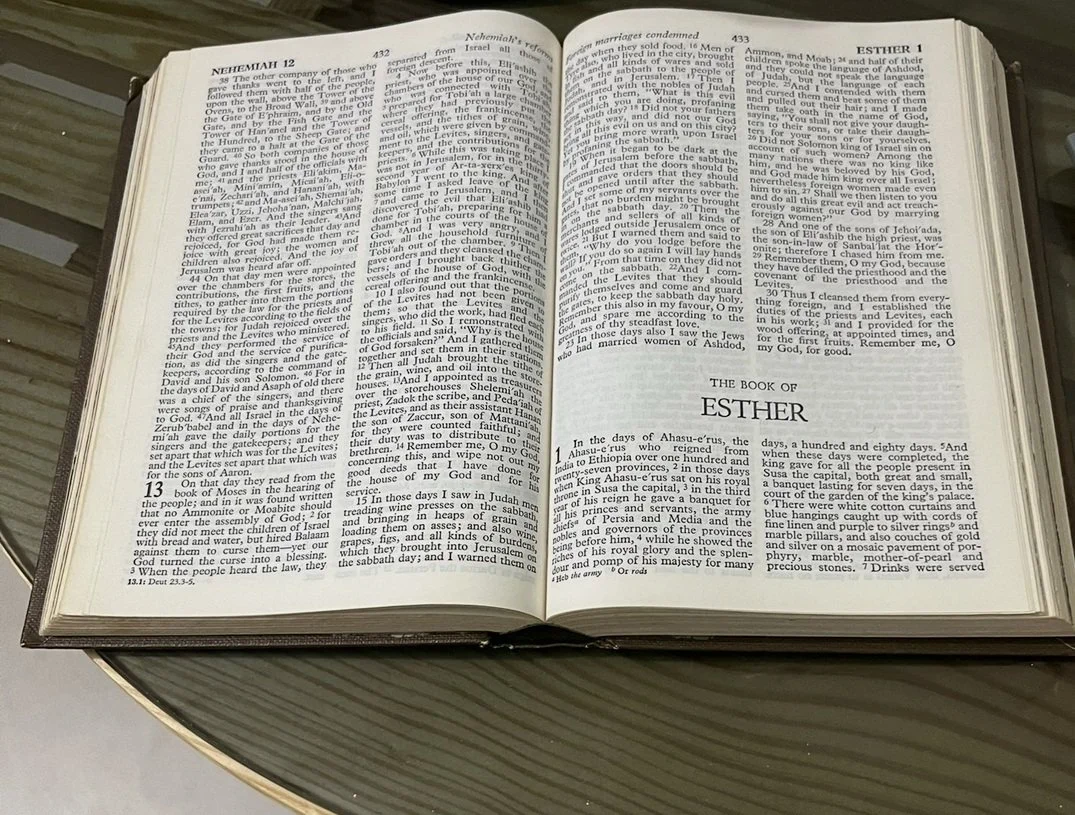
Montego Bay, Jamaica. October 2024.
For how can I endure to see the tragedy that will happen to my people? Or how can I endure to see the destruction of my kindred?
Esther 8:6 (AMP)
Glory be to God.
How the practice works
The Esther Practice examines how racialised harm happens, how institutions respond, and what allows it to persist. It looks beyond the immediate act to the dynamics around it:
The complicity.
The responses.
The silences that allow it to continue.
Rather than focusing only on individual incidents, the practice looks at the patterns that sit underneath them.
What is repeated.
What is tolerated.
What remains unspoken.
The work does not seek to soften or reframe harm to make it more comfortable.
It brings it into focus, so it can be understood and addressed for what it is.
This is done through clarity, accountability, and direct engagement with what has too often been normalised
Research interviews are shaped by counselling training and principles. Experiences are listened to without dismissal, defensiveness, or pressure to make them more comfortable for others.